The Bank of England's Financial Stability Report published today puts hyperscalers' total potential exposure at just over $4 trillion,…
The Bank of England's Financial Stability Report published today puts hyperscalers' total potential exposure at just over $4 trillion, based on internal Bank estimates. That includes debt, leases, purchase commitments and contingent obligations such as guarantees and backstops. It is potential exposure, not a forecast of losses. I keep coming back to the scope of that number.
The report projects hyperscaler bond issuance above $305 billion in 2026, around 8% of global investment-grade issuance. It also describes firms that can be investors, customers and suppliers at once. I want to understand how those overlapping roles affect where the obligations ultimately land.
Contractual commitments can give financing vehicles expected revenues to service debt. I can see how that supports financing. The question I keep coming back to is what happens if expected AI revenue disappoints. Which firms and investors carry the strain then? AI's usefulness and the enthusiasm around it do not answer that underwriting question.
The BoE warns that complex financing can obscure risk concentrations and allow stress to spread. It also says spillovers have so far been limited and the UK financial system resilient. I read this as a reason to trace the commitments and ask whether promised revenue covers them.
Sources:
Bank of England: https://www.bankofengland.co.uk/-/media/boe/files/financial-stability-report/2026/financial-stability-report-november-2026.pdf
Reuters via Euronext: https://live.euronext.com/en/financial-news/bank-england-sees-growing-financial-risks-ai-borrowing-surges
Not financial advice. For informational and educational purposes only.
I think $NTNX investors have two things to weigh together: recurring revenue is growing, and the company is heading into a CEO…
I think $NTNX investors have two things to weigh together: recurring revenue is growing, and the company is heading into a CEO transition while bookings and retention have softened. Q1 FY2027 annual recurring revenue reached $2.63…
For $HPQ shareholders, the 29% drop in PC units is the number I'd weigh against the 14% revenue gain.
For $HPQ shareholders, the 29% drop in PC units is the number I'd weigh against the 14% revenue gain. I want to see what that growth earns before reading it as a demand rebound. Personal Systems revenue reached $11.8 billion, up 14%,…
Mega-Cap Net Margins
NVIDIA reported a higher net margin than Alphabet, while investment gains complicated comparisons of recurring profitability.
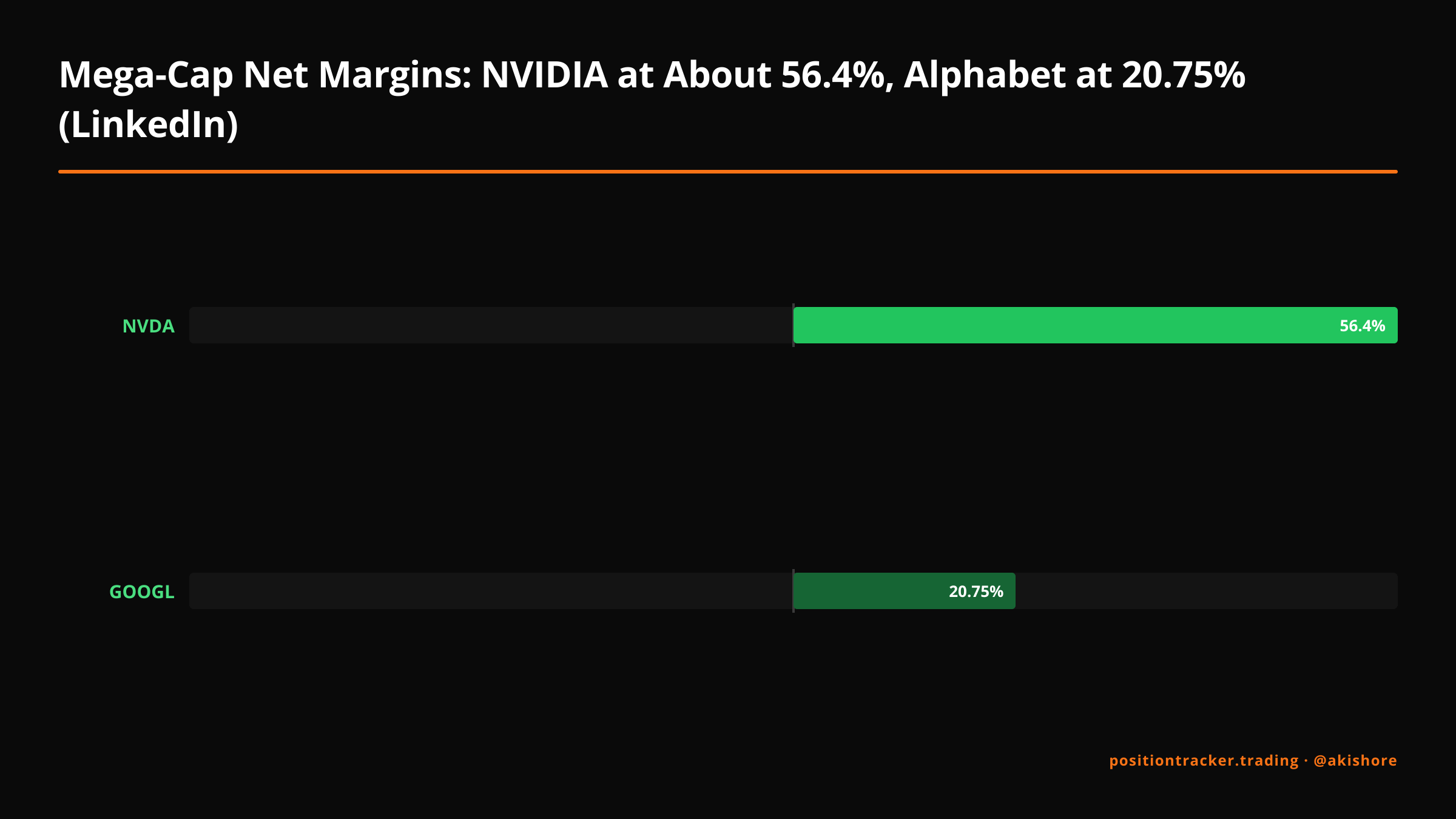
NVIDIA reported roughly a 56.4% net margin in its latest quarter, on $65.3 billion of net income and $115.844 billion of revenue. Alphabet's latest margin was 20.75%, on $26.468 billion of net income and $127.577…
The Power Law — NVIDIA's swings put concentration in focus
NVIDIA shares fell after the company beat quarterly estimates, underscoring the concentration risk explored in The Power Law.
U.S. stock markets are closed for Thanksgiving. NVIDIA's latest completed session still offers a sharp picture of concentration risk: shares fell as much as 9.15% from the previous close before recovering to finish at $149.30, down 3.91%. The company's market value is about $3.60 trillion.