Cheaper inference from routing and caching on the same GPUs is the part of the AI capex story I actually like.
Cheaper inference from routing and caching on the same GPUs is the part of the AI capex story I actually like. llm-d 1.0 points that way, but every headline number so far comes from the project's own sponsors.
- Contributors released v1.0 of llm-d on Oct. 20, 2026. It's an open-source, Kubernetes-native distributed inference stack, founded in 2025 by Red Hat, IBM, Google Cloud, CoreWeave and NVIDIA, and now a CNCF Sandbox project.
- In an IBM demonstration, GLM 5.2 (about 753B parameters) peaked above 6.6 million output tokens per minute and served up to 3,000 concurrent coding agents without preemptions.
- IBM Research reports one workload at about $0.11 per million tokens with a ~98% prefix-cache hit rate, 11.5x cheaper than an all-proprietary configuration. IBM separately estimates 5-10x lower per-token cost versus commercial API pricing at current cloud rental rates.
- The savings come from serving infrastructure, so results depend on workload, hardware and cache behavior. A 98% hit rate is a friendly setup.
If cost per token keeps falling like this, more AI names have a path to real cash flow, which is what would push me off my mixed view on AI capex. What I'd watch next: hyperscalers outside the founding group adopting it, and whether anyone outside IBM reproduces the 11.5x.
Source:
eeNews Europe: https://www.eenewseurope.com/en/llm-d-1-0-targets-lower-ai-inference-costs/
Not financial advice. For informational and educational purposes only.
In July, Treasury fined a US company $200,000 because a subsidiary failed to report a $92,478 investment in a Chinese AI and robotics…
In July, Treasury fined a US company $200,000 because a subsidiary failed to report a $92,478 investment in a Chinese AI and robotics company. Treasury announced that first-ever penalty on Oct 7. It's the enforcement backdrop for the proposed rule Treasury put out on Thursday, Oct 22, and I think it tells you how seriously this program is going to…
Viral chart: global stocks down ~$10T from highs, South Korea -43%; a 43% drop needs a 75% gain to recover
A chart going around X this weekend says global stock markets have lost about $10 trillion from their yearly highs, with South…
US semiconductor producer prices +26% YoY in September; at that pace chip prices double in about 3 years
US producer prices for chips and electronic components rose 26% YoY in September, the 6th…
Black Monday 1987 — 22.6% in a Day, Still the Benchmark
On October 19, 1987, the Dow fell 508 points, or 22.6%, closing at 1,738.74 versus 2,246.74 on October 16, still the Dow's worst one-day percentage…
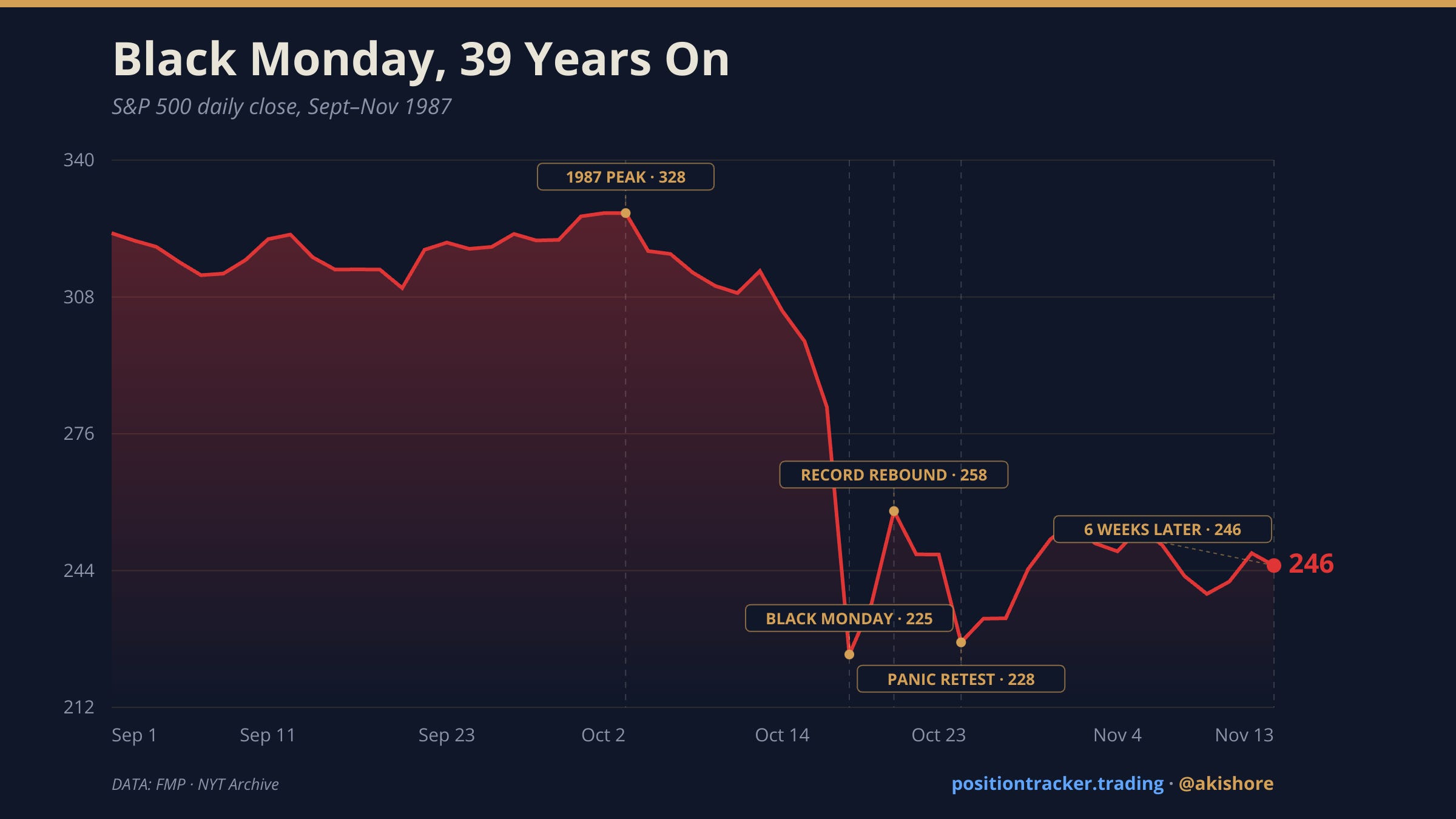
On October 19, 1987, the Dow fell 508 points, or 22.6%, closing at 1,738.74 versus 2,246.74 on October 16, still the Dow's worst one-day percentage decline on record. The S&P 500 dropped 20.47%, from 282.70 to 224.84, its own worst day. Analyses…