A WSJ analysis finds nine major tech firms hold about $3 trillion in AI commitments.
A WSJ analysis finds nine major tech firms hold about $3 trillion in AI commitments. These are mostly purchase deals and leases not yet on their balance sheets.
This amount is much larger than the $600 billion in reported capex from these same companies. The gap shows how much future spending is already locked in.
Financing plans are shifting to match this scale. Goldman Sachs expects bond sales by $AMZN, $GOOGL, $MSFT, $META and $ORCL to hit $250 billion in 2026.
Forecasts point to roughly $400 billion in bond sales by 2027. Hyperscalers plan to borrow heavily to fund their AI infrastructure buildout.
Two financial pictures are forming at once. One tracks capital used under current accounting rules.
The other captures future obligations through contracts and debt. These will shape cash flows for years to come.
Investors who rely only on reported capex miss most of the story. They see just a fraction of the true resource commitment driving this cycle.
Market moves today highlight this tension. $MSFT dropped 3.4% and $META fell 4.3% before slight recoveries.
Broader pressure came from higher oil prices and rising long-term yields. These factors added to the intraday volatility.
Assessing leverage now requires more than standard filings. Debt forecasts must be read alongside them.
Reported capex is no longer the complete picture. Both data sources are needed to understand the real financial exposure.
Not financial advice. For informational and educational purposes only.
$DECK daily pick: sell Dec 18 $75 put (buy-side)
$DECK: I'm selling the Dec 18 $75 put and getting paid to wait on the @hoka and @UGG owner. As of Friday's close ($81.09, markets are closed today): 19% below the 200-day and 34% off the February high Credit $1.90 for ~2.5% in 54 days (~17% annualized) Breakeven $73.10, about 10% below Friday About 10.5x this fiscal year's EPS estimate…
S&P 500 up after all 19 midterms since 1950; at a 70% base rate that streak is roughly 1 in 880
With US midterms on November 3, traders are sharing the stat that the S&P 500 rose in the 12 months after all 19…
S&P Global US Manufacturing PMI hits 56.0 in October, beating the 55.5 consensus by half a point
US manufacturing PMI hit 56.0 in October, the highest since May 2022. The Street expected a dip. Factory hiring was…
Energy Leads Alone as Defensives Lag
Energy led all sectors at +2.60%, more than five times the next-best gain in Information Technology (+0.49%), while eight of eleven sectors finished negative.
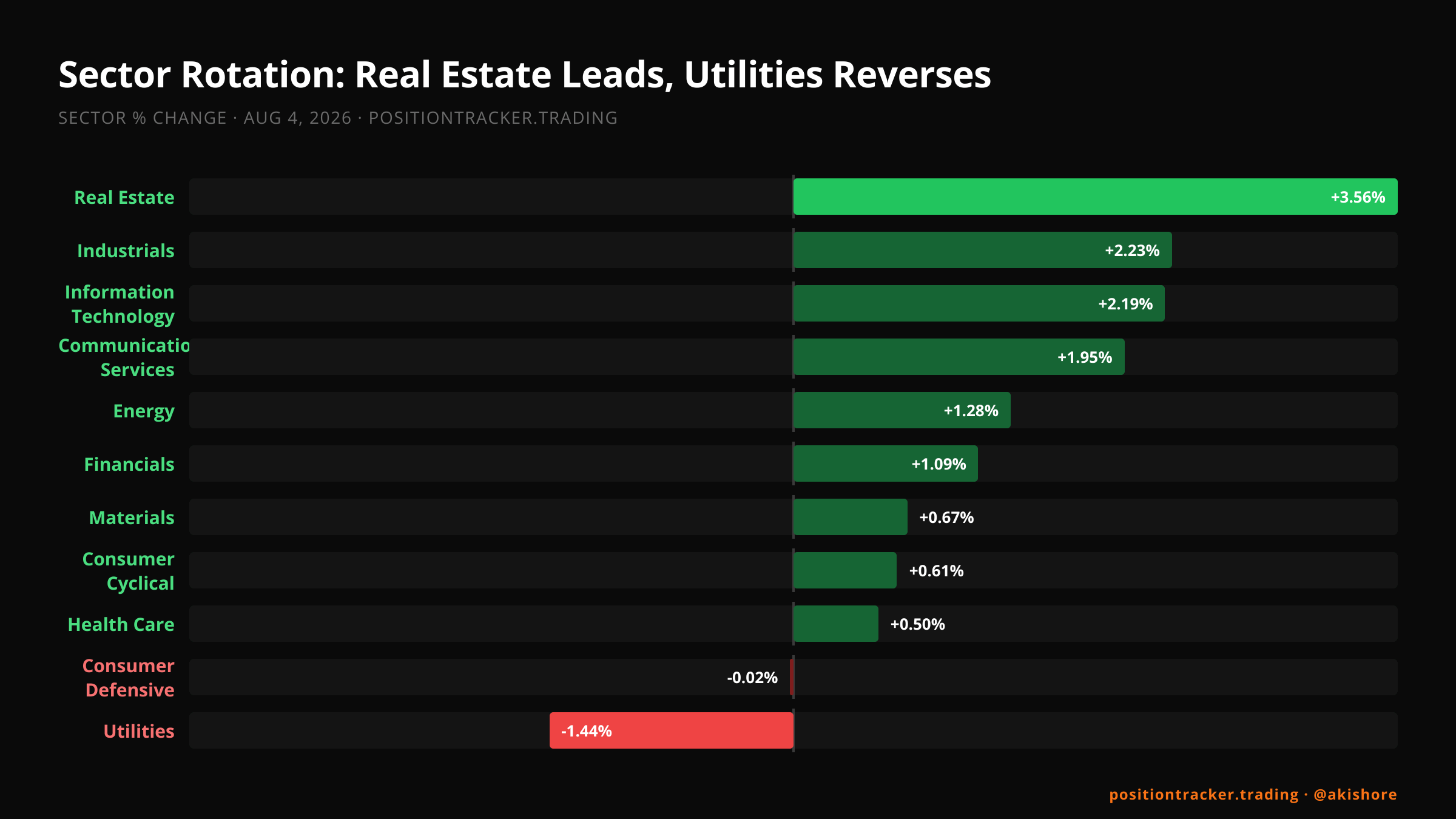
Energy returned +2.60% in Friday's session, the largest gain among all tracked sectors and more than five times the next-best, Information Technology at +0.49%. Only three of eleven sectors finished positive, with Real Estate barely in the green at +0.12%. The narrowness…