Goldman Sachs cut its 12-month Kospi target by 25% this weekend, to 9,000 from 12,000, and in the same note said it remains bullish on…
Goldman Sachs cut its 12-month Kospi target by 25% this weekend, to 9,000 from 12,000, and in the same note said it remains bullish on Korea. Timothy Moe's team says the new target still implies more than 60% upside. That tells you how far the index has already fallen: the Kospi closed today at 5,469.47, down 1.46%, at a roughly seven-month low and about 35-40% below its June peak.
The detail I keep coming back to is the reason. Moe says the downgrade comes from incorporating "more conservative assumptions about how the market may price underlying fundamentals." Goldman also said the market is pricing an overly negative fundamental outlook. In plain terms, the cut is framed around the valuation multiple Goldman expects investors to pay, not a collapse in earnings estimates.
That matters beyond Korea. SK Hynix and Samsung are widely seen as the picks-and-shovels of the AI boom, and they report this week, SK Hynix on Wednesday and Samsung on Thursday.
By MarketWatch's count, semiconductor stocks make up almost one-fifth of the S&P 500. Today, chip stocks were among the weakest names in Japan and Chinese AI model developers slumped, amid renewed doubts about returns on AI infrastructure spending and ahead of big US tech earnings.
So my question is this. If one of the biggest banks on the Street is now haircutting what the market will pay for AI-linked earnings in Seoul, how long before that same multiple math gets applied to the US chip names everyone owns?
Sources:
MarketWatch: https://www.marketwatch.com/story/the-kospi-index-is-the-leading-indicator-for-the-global-ai-trade-and-goldman-just-slashed-its-forecast-by-25-ccfe2690
Investing.com via Yahoo Finance: https://finance.yahoo.com/markets/world-indices/articles/goldman-sachs-cuts-kospi-target-092052012.html
Not financial advice. For informational and educational purposes only.
Anthropic targets November 16 IPO week, could raise ~$100B at up to $2T valuation
Anthropic is aiming to go public the week of November 16 and could raise roughly…
Video explainer: @AnthropicAI just made its IPO filing public. $16.3B in revenue next to an $80.7B loss in just six months.
@AnthropicAI just made its IPO filing public. $16.3B in revenue next to an $80.7B loss in just six months. It plans to list on the @Nasdaq as $ANT with @GoldmanSachs and @MorganStanley leading. Per @CNBC marketing could start the week of Nov 9.
Roughly 87x forward earnings after losing more than half its value.
Roughly 87x forward earnings after losing more than half its value. Arm holders are the ones most exposed on November 4, because at this multiple a merely good quarter may not be enough. $ARM was at $212.78 in pre-market on October 26, up 1.16% from…
Energy Leads Alone as Defensives Lag
Energy led all sectors at +2.60%, more than five times the next-best gain in Information Technology (+0.49%), while eight of eleven sectors finished negative.
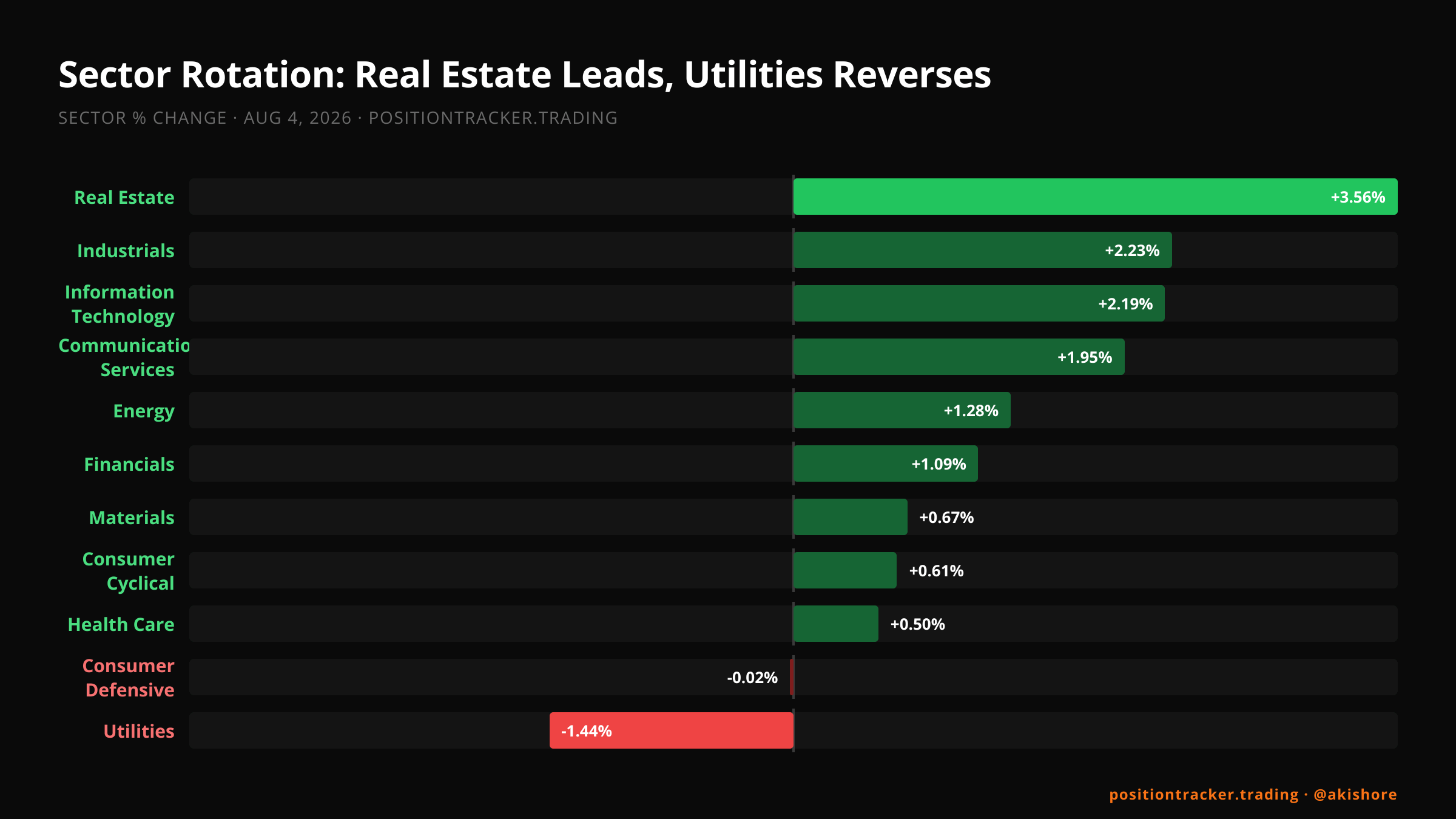
Energy returned +2.60% in Friday's session, the largest gain among all tracked sectors and more than five times the next-best, Information Technology at +0.49%. Only three of eleven sectors finished positive, with Real Estate barely in the green at +0.12%. The narrowness…