OpenAI and Broadcom built the Jalapeño inference chip in about 9 months—from concept to tape-out—on a 3nm process.
OpenAI and Broadcom built the Jalapeño inference chip in about 9 months—from concept to tape-out—on a 3nm process. That's one of the fastest high-performance ASIC cycles on record. The chip is purpose-built for LLM inference, not a repurposed training design.
Broadcom CEO Hock Tan stated it delivers roughly 50% lower cost per inference compared to typical AI GPUs. This is a targeted move to cut one of the largest operating expenses in running large models at scale, with OpenAI exploring hardware options to achieve this goal.
The initial deployment window is late 2026, with ramping volume after that. If Jalapeño hits its targets, it could pressure Nvidia's inference margins, where much of the current AI infrastructure spend sits.
What makes this notable is the specificity: a named cost target, a clear timeline, and a partner like Broadcom with execution credibility. Most AI chip projects never make it to tape-out, let alone with a 50% cost delta in sight.
Broadcom's next earnings call will be worth watching. Any mention of volume commitments or production plans for Jalapeño could signal how serious this push really is.
For now, $AVGO trades at $363.35, down 2.8% today. The market hasn't priced in a near-term disruption to AI infrastructure economics, but OpenAI and Broadcom are clearly building as if they intend to make one.
Will this chip shift the balance, or just ease OpenAI's own costs? Depends on how widely it's adopted beyond their own stack.
Not financial advice. For informational and educational purposes only.
$DECK daily pick: sell Dec 18 $75 put (buy-side)
$DECK: I'm selling the Dec 18 $75 put and getting paid to wait on the @hoka and @UGG owner. As of Friday's close ($81.09, markets are closed today): 19% below the 200-day and 34% off the February high Credit $1.90 for ~2.5% in 54 days (~17% annualized) Breakeven $73.10, about 10% below Friday About 10.5x this fiscal year's EPS estimate…
S&P 500 up after all 19 midterms since 1950; at a 70% base rate that streak is roughly 1 in 880
With US midterms on November 3, traders are sharing the stat that the S&P 500 rose in the 12 months after all 19…
S&P Global US Manufacturing PMI hits 56.0 in October, beating the 55.5 consensus by half a point
US manufacturing PMI hit 56.0 in October, the highest since May 2022. The Street expected a dip. Factory hiring was…
Energy Leads Alone as Defensives Lag
Energy led all sectors at +2.60%, more than five times the next-best gain in Information Technology (+0.49%), while eight of eleven sectors finished negative.
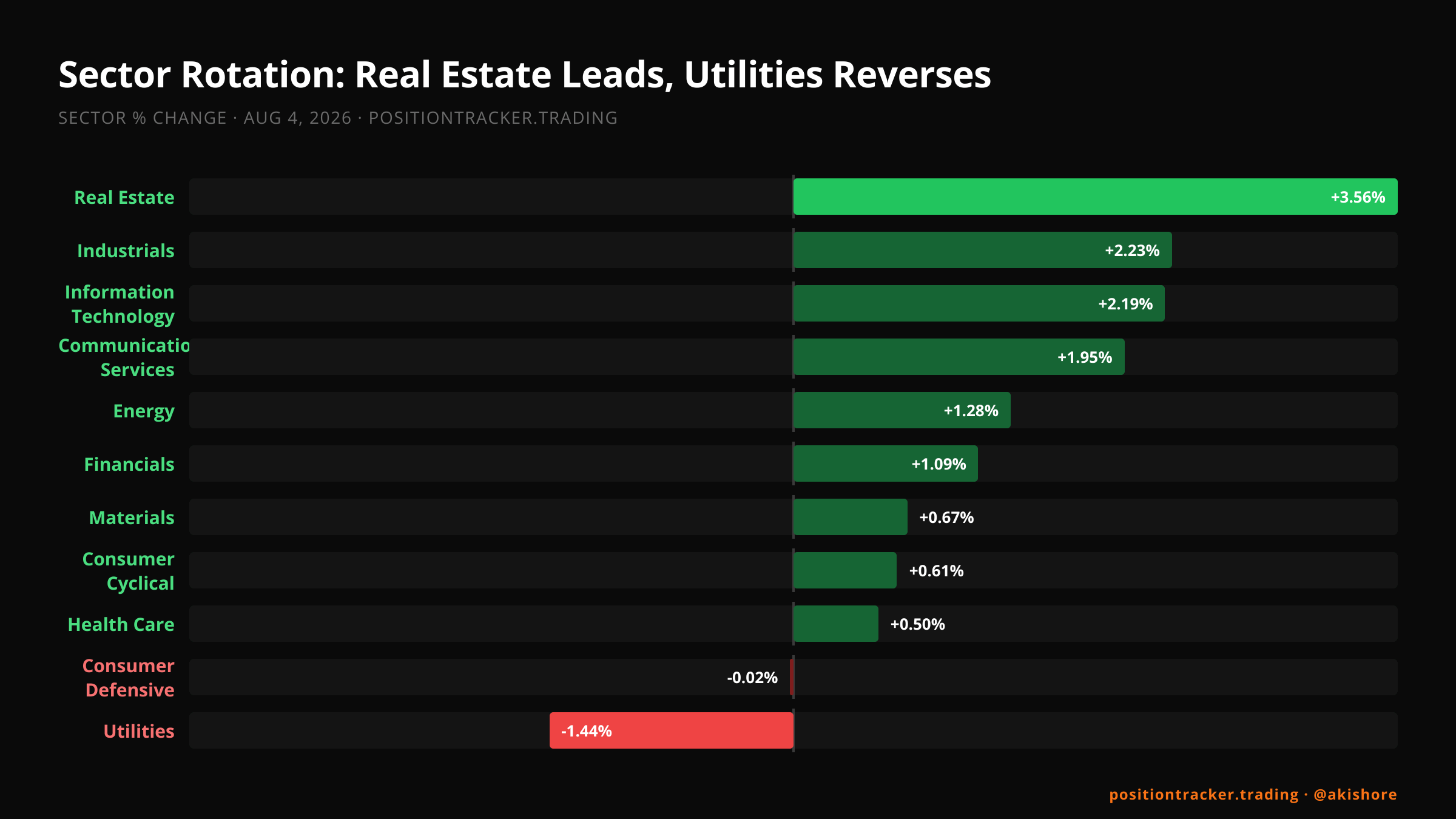
Energy returned +2.60% in Friday's session, the largest gain among all tracked sectors and more than five times the next-best, Information Technology at +0.49%. Only three of eleven sectors finished positive, with Real Estate barely in the green at +0.12%. The narrowness…